
This newsletter includes:
- Closing up for Winter
- The background to our work at Dune #1
- A rethink of bug behavior
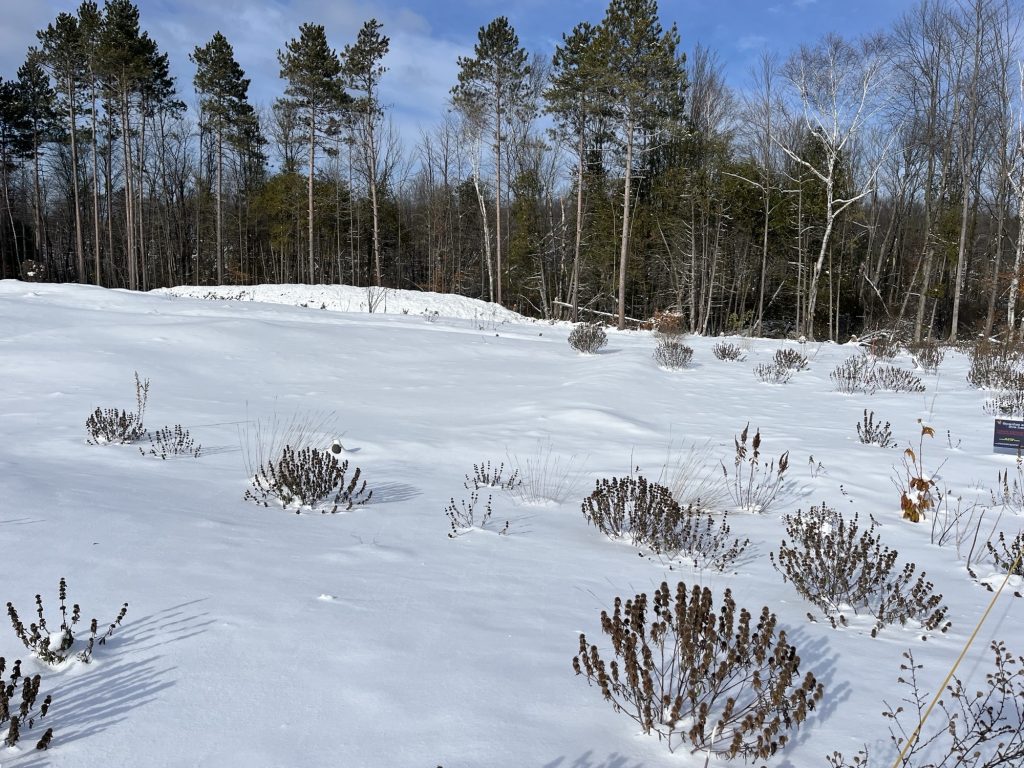
Winter Closes In and The Dunes Close Down for the Year
Temperatures dropped in November but the volunteer team was able to keep on working through to mid-month, mainly doing final debris-gathering in Dune #1, raking leaves, and seed-harvesting in Dune #2.
The work done by volunteers has been stellar and the Friends of Pinhey Sand Dunes thanks everyone for all their efforts. We look forward to welcoming volunteers and visitors back next year. Keep an eye on our social media, website, and newsletter for starting dates.
The mural for the side of the shipping container and the wings for the doors are now complete – kudos to the art team – and stored away. Mounting will happen in 2026 on an expected new and larger container. This will be the locus for, hopefully, expanded activities from 2026.
A big activity over recent weeks has been harvesting the seeds of the spotted beebalm (Monarda punctata). This plant has been self-seeding very successfully in the sandy soil of the dunes and is now rife, even as household gardeners struggle to keep it going at home. In the interest of ensuring diversity in the dunes, we have been gathering seeds to prevent further spread. The dried crowns hosting tiny black seeds will be shared with the Ottawa seed banks and with a botanist doing nature conservancy at Rice Lake. “We are lucky the beebalm is doing so well here and we can share with others who need it,” said Friends of Pinhey Sand Dunes chair Berit Erickson.
Meanwhile, the swallowtail chrysalises that are hooked onto the covered netting and plants inside will be housed inside the shipping container over winter to get ready to emerge next spring.
Dune #1: Where Our Restoration Work All Started
By Chris Dragan
Dune #1 was where Biodiversity Conservancy International started its dune restoration work. We have pictures of it dating from 1925. Since then, all our activities have been geared towards restoring the dune’s geomorphic processes: to allow wind and sand to interact as they once did 10,000 years ago in this rare inland dune system.
In the 1980s, the dune was used as a party spot and known as “the Sand Pit”. People held bonfires, went mountain biking, and let their dogs run loose in the sand. To this day, we still find debris left over from these activities.
In 2012, the Friends of the Pinhey Sand Dunes obtained a grant from the National Capital Commission (NCC) to restore the dunes, starting with this one. If left alone, the dune would be taken over by plants from the forest, as it has been over the past decades, which would deprive us of one of Canada’s most unique geological sites.
Since then, we’ve cleared the forest around the “Sand Pit”. In particular, we’ve removed trees, such as balsam poplar (Populus balsamifera), and blackberries (common on the East side of Dune #1), the latter taking four dedicated passes to eradicate. Invasive bladder campions (Silene vulgaris) took three years to remove, and managing the crabgrass (Digitara sanguinalis) is a daily struggle. Poison ivy (Toxicodendron radicans) likes to grow at the edge of the dunes since there is more calcium there, but these plants are easy to uproot.
In 2022, a large windstorm known as a Derecho was a mixed blessing for our work: it knocked down a lot of surrounding trees, revealing more of the dune underneath. The site was closed to volunteers after the Derecho which led to the dunes to start “greening” again. In particular, the winds delivered daisy seeds from Merivale gardens to all of the dunes (we’ve since removed these thanks to a special hoe used to cut these flowers).
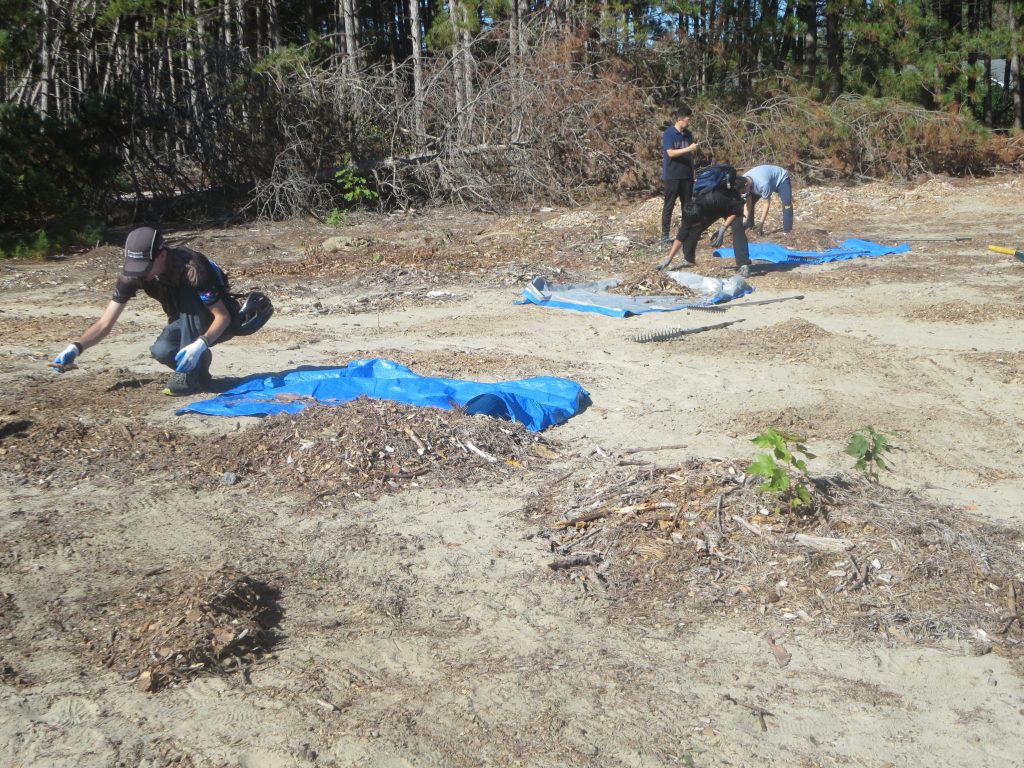
In October this year, the NCC bulldozed the fallen trees up to the treeline and pushed all of the large debris to the edges, towards a burn pile at the Northwest side of Dune #1. However, they also turned the fallen trees into wood chips which contaminated swathes at the edge of the dune. So we’ve had to do a lot of root clearing and sifting since then to remove these in order to ensure finer and cleaner sand is left behind for the dune’s native species.
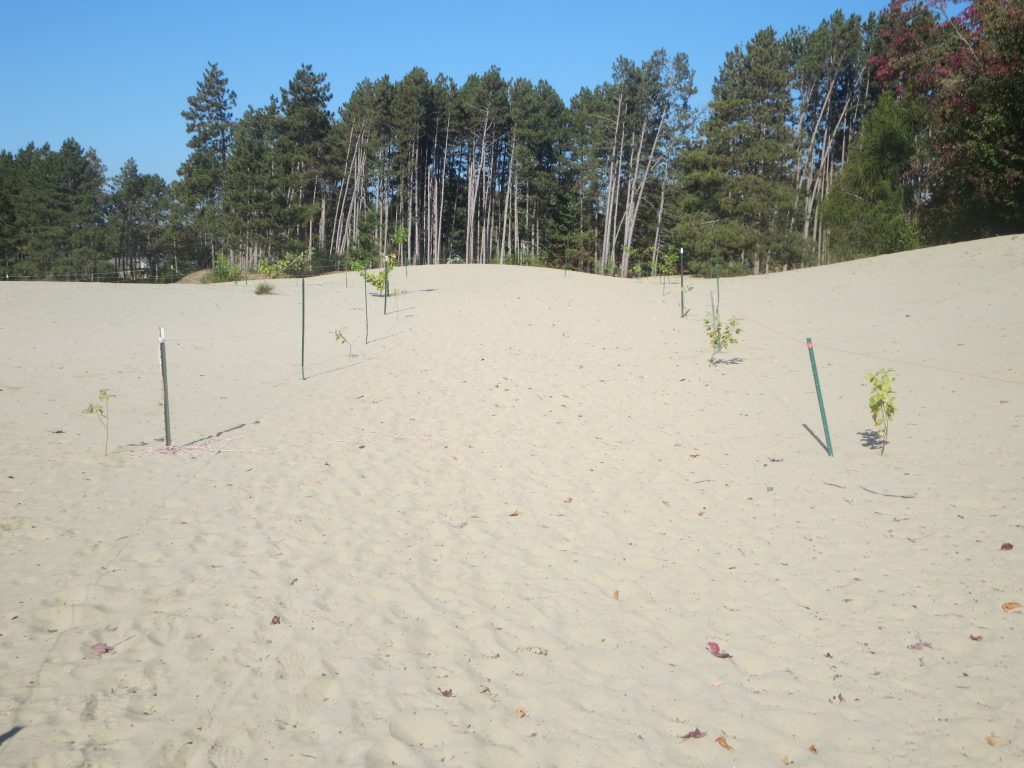
The team at Dune #1 has also planted hogtree and New Jersey tea plants (Ceanothus americanus) in an effort to provide host plants for migratory butterflies. These plants are perfectly suited to the dune environment since they don’t affect other species and won’t proliferate beyond what we can handle.
We will provide an update in future newsletters.
“A Bug’s Life” Wasn’t Wrong: What Insects at Ottawa’s Sand Dunes Can Teach Us About Personality
By Alyssa Nolan
When the sand starts to shimmer with heat at Ottawa’s Pinhey Sand Dunes, the Festive Tiger Beetle (Cicindela scutellaris) disappears. One moment it’s skimming the surface; the next, it’s gone, and tucked into a shallow burrow beneath the sand. In these hidden shelters, the beetles wait out the hottest hours, emerging again only when the air cools and shadows stretch long across the dunes. Nearby, the Big Sand Tiger Beetle (Cicindela formosa) prowls the open sand, hunting under skies that heat the surface above 70°C. If you’ve ever thought insects were mindless specks in nature’s background, the Pinhey dunes would like to change your mind.
The Hidden Personalities of Insects
Scientists once believed that small-brained animals like insects couldn’t have individual quirks. But research tells a different story.
Even genetically identical fruit flies show consistent differences in how active, aggressive, or social they are. In firebug studies, researchers found individuals that reliably chose risk, or retreated. Some bugs explored every corner of their test arena. Others hugged the walls, cautious and predictable. These findings are repeatable, and measurable.
It is what researchers now call “animal personality,” stable behavioral differences between individuals. However, it gets stranger. And more wonderful.
Tiny Brains, Big Feelings?
Cognitive ethologist Lars Chittka and others have shown that bees can count, recognize patterns, learn from observation, and even show what we might call “mood”. In one experiment, bees rewarded with surprise sugar treats became more optimistic, approaching ambiguous colours as if good things were coming. Deprived bees acted warier.
And some bumblebees? They roll tiny wooden balls for no obvious reason. Not for food. Not for mates. Possibly…for fun.
If this sounds eerily familiar, it’s because it is. These are emotions, or at least their evolutionary cousins. Perhaps we share more in common with bugs than we once thought.
Life on the Edge: The Pinhey Sand Dunes
Now, let’s zoom back into the Pinhey Sand Dunes.
These dunes host many insects adapted to extremes. Ghost tiger beetles (Ellipsoptera lepida) patrol hot sand. Some travel over a kilometre to hunt. Others stick close to shade. Bold individuals seek out opportunity, while cautious ones avoid danger.
In harsh, patchy ecosystems like sand dunes, personality may be a survival tool. Bold beetles explore farther for, new prey, but face greater heat and risk. Cautious beetles might avoid danger but miss opportunity. Social tendencies could affect disease spread or group survival. And playful behaviors may hint at mental flexibility that helps insects adapt to change.
Why It Matters
Understanding insect lives matters. Recognizing personality in insects reshapes how we approach conservation. It’s not enough to simply protect species, we must consider the range of behaviours and temperaments within those species. A bold beetle and a cautious beetle may need different kinds of shelter. A curious bee might thrive in varied floral landscapes, while a more reserved one may not stray far from familiar blooms. Restoring habitats like the Pinhey Sand Dunes means thinking small, really small. We must preserve the microhabitats that support not only biodiversity, but behavioural diversity. These subtle environmental features may be the difference between survival and disappearance for species with specialized needs.
Final Thoughts: The Theatre Beneath Our Feet
As entomologist Mary Jane West-Eberhard wrote, “Insects are the silent storytellers of the natural world, narrating tales of survival, adaptation, and coexistence.” Nowhere is that more evident than at the Pinhey Sand Dunes, where each shifting grain of sand sets the stage for countless lives. If we believe a bee can be optimistic, or a beetle can choose boldness, we start to see these dunes differently: Not just a place of identikit insects but as diverse as our own homes. Maybe A Bug’s Life wasn’t fiction after all. Maybe it just saw something most of us missed.
Background Works
Babits, Melinda. “What Studying Firebugs Taught Me about Personality.” TED Ideas, 7 Sept. 2023, https://www.ted.com/talks/melinda_babits_do_insects_have_personalities
Chittka, Lars. “Do Insects Feel Joy and Pain? Insects Have Surprisingly Rich Inner Lives—a Revelation That Has Wide-Ranging Ethical Implications.” Scientific American, 1 July 2023, www.scientificamerican.com/article/do-insects-feel-joy-and-pain/
Chittka, Lars. The Mind of a Bee. Princeton University Press, 2023.
Dang, P.T., and Stephen Aitken. “Conservation of Sand Dune Systems in Canada’s Capital.” ResearchGate, 2014, https://www.researchgate.net/publication/271938646_Conservation_of_sand_dune_systems_in_Canada’s_capital_a_restoration_model_and_case_study_of_the_Pinhey_Sand_Dunes_complex
Jane’s Walk Ottawa “Description of Pinhey’s Ecology: Heat, Restoration, and Insect Habitat.” 2023. https://www.janeswalkottawa.ca/en/walks/jane-s-walk-ottawa-gatineau-2019/19951
iNaturalist Contributors.“Cicindela formosa.” iNaturalist, 2023. https://www.inaturalist.org/taxa/82456-Cicindela-formosa-formosa
iNaturalist Contributors.“Cicindela Scutellaris.” iNaturalist, 2023. https://www.inaturalist.org/taxa/82435-Cicindela-scutellaris
iNaturalist Contributors. “Ellipsoptera lepida.” iNaturalist, 2023, https://www.inaturalist.org/taxa/120478-Ellipsoptera-lepida
Kralj-Fišer, Simona, and Winfried Schuett. “Studying Personality Variation in Invertebrates: Why Bother?” Animal Behaviour, vol. 91, 2014, pp. 41–52.
Mollá-Albaladejo, Rubén, and Juan A Sánchez-Alcañiz. “Behavior Individuality: A Focus on Drosophila melanogaster.” Frontiers in physiology vol. 12 719038. 30 Nov. 2021, doi:10.3389/fphys.2021.719038
Nature Conservancy of Canada, Jane’s Walk Ottawa, and Canadian Geographic. “Pinhey Sand Dunes: Restoration and Biodiversity.” 2023.
ResearchGate, Backcountry Gallery Photography Forums, and Canadian Geographic. “Tiger Beetle (Ghost/Bronzed) at Pinhey and Its Adaptations.” 2023. https://bcgforums.com/threads/ghost-tiger-beetles.37530/