
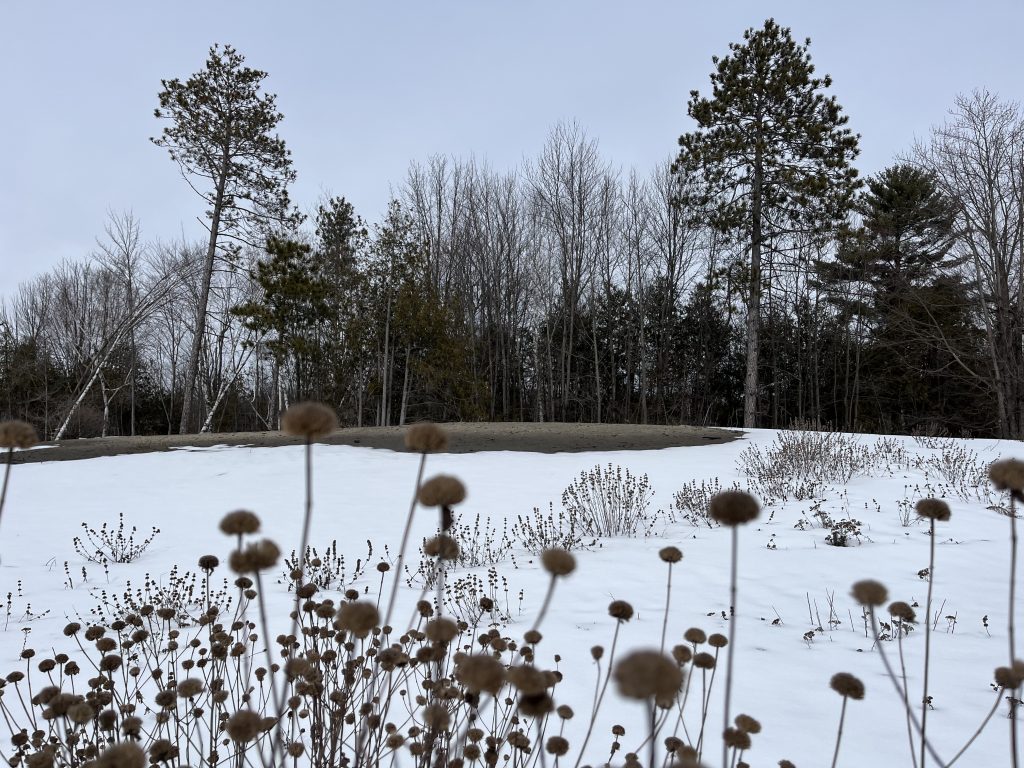
The weather has been ever-changing, with snow melting and then falling again. But as of the end of March, we are seeing the tops of the dunes emerging from the white. As with the dunes themselves, executive committee members are looking forward to spring and the dunes reopening.
Onsite, there is little to do. But we continue to monitor and manage the ropes and signage to keep casual walkers and dogs on the proper paths so the dunes are relatively undisturbed.
This newsletter includes:
- Volunteer Event at Carleton University
- An introduction to explorer and expert, Andrew Mott
- A geological history of the dunes
Volunteer Event at Carleton University
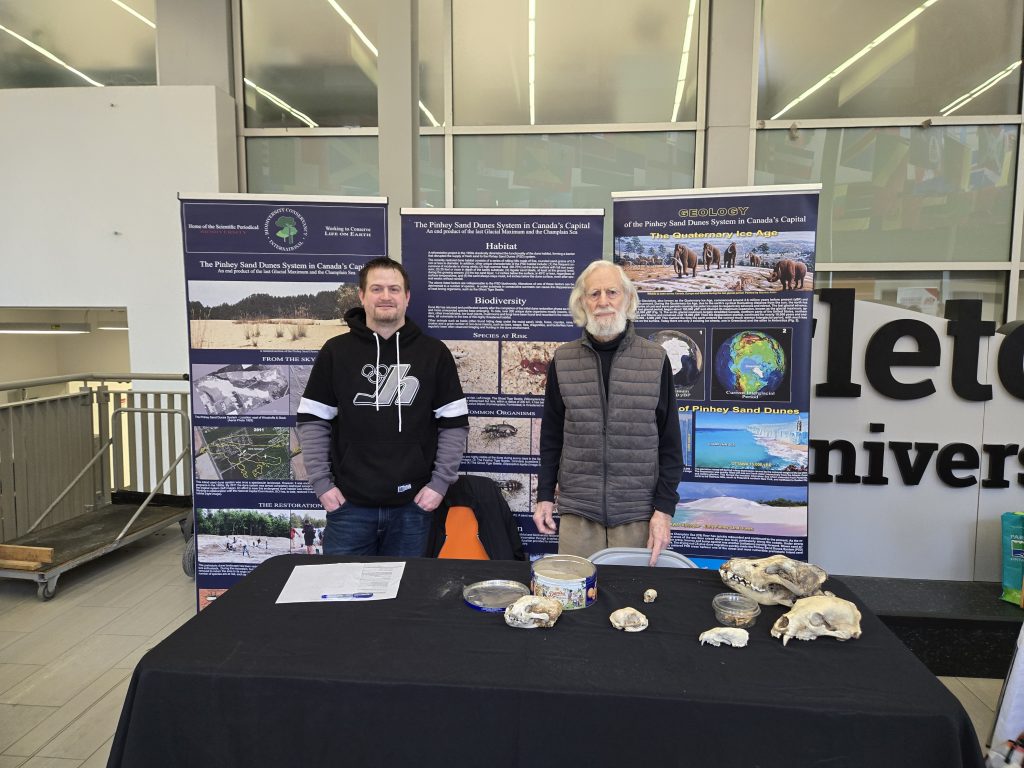
Frank Moore and Andrew Mott represented the Pinhey Sand Dunes project at the Carleton University Volunteer Fair on March 10. A stream of people dropped by to find out more, which will hopefully mean strong volunteer interest in supporting the dunes. It also increases our name recognition in the Ottawa community. We will be present at other Volunteer Ottawa and Pollinator Appreciation Day events in coming months and information will also soon go up on our social media channels.
Introducing Andrew Mott, a Key Pillar of the Pinhey Dunes
By Karen Lane
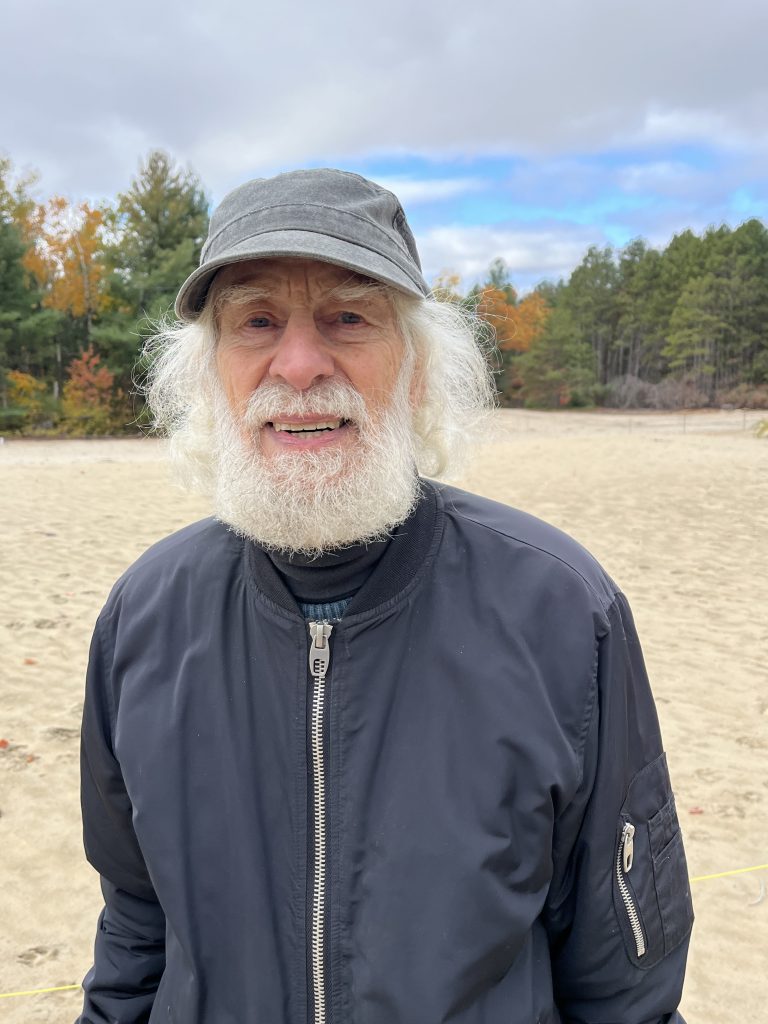
For Andrew Mott, it’s all about the adventure. And the Pinhey Sand Dunes are just the latest in a series of exciting ecological journeys.
Andrew, born in the Derundun Hill Station north of New Delhi in India, has been in Ottawa since the 1980s, and involved with the reclamation and restoration of the dunes since 2011 along with Pete Dang and Henri Goulet. He wants to see the dunes become a major site for Canada’s capital city.
“I believe they are hugely valuable as an iconic conservation area, and that people should be able to enjoy them as long as the sand is here. That is why we do conservation,” he said. “I think it should be as important to Ottawa as the Tulip Festival.”
Not only that, but the dunes should serve multiple purposes to make sure they meet many short- and long-term, and very differing research, general interest, and sustainability needs for both humans and the flora and fauna: “We need to keep parts for real science and rare creatures, and have a public space for people to visit and learn.”
For that reason, you will often see Andrew – in his trademark wide brimmed hat – explaining to visitors about the dunes, or showcasing animals and plants to help volunteers better understand this unique site. At one time, this even included former Prime Minister Justin Trudeau, visiting the dunes incognito.
Andrew’s involvement with the world’s flora and fauna is long-standing. He spent his early years in India speaking, as he said, “more Hindi than English” despite having a Canadian mother and English father. He then moved back to England for schooling, eventually learning about trees and tree management with the UK’s Forestry Commission. Later, through a job at a large UK zoo, he developed a lifelong interest in animals too.
He traveled to India in search of birds for the zoo, and worked as an officer on a merchant ship transporting lumber from Japan to the US. Seeking more adventure, he made a memorable – and near fatal – trip to the Galapagos Islands in 1968, long before it was a formal conservation or tourist site, to support a visit by a team led by English Himalayan mountaineer, Eric Shipton, to map volcanoes and monitor the then-less-famous giant turtles.
Moving to Montreal in 1969, then Ottawa over a decade later, Andrew joined Carleton University as a technician with its biology and life sciences and, later, psychology departments where he developed an expertise in reptiles and was tasked with presentations about them. It was then, through colleagues, that he met Pete and started coming to the Pinhey Sand Dunes to monitor the snake population and became more involved with the dune reclamation. And when the National Capital Commission provided funding and support in 2011, was able to lend his broader expertise about trees and animals to the project.
For him, it’s all about being hands-on and transferring his knowledge. “You can hear about animals and plants, but it’s different to come here and see. We need to teach kids to hold things, and be part of the dunes,” he said. He hopes, over time, that the dunes will become larger and, with its proximity to the city, attract both scientists and others, like him, keen to know more.
Tracing the Glacial History of Pinhey Sand Dunes
By Andrew Mott
One billion years ago, the Gatineau/Laurentian mountains were an immense chain of mountains comparable to the younger Himalayas, but many an ice age has come and gone since then, reducing their majesty.
We are now living in the Late Cenozoic Ice Age, which started 34 million years ago with the formation of the Antarctic ice sheets. This era has had many glacial periods which, on average, lasted for about 70,000 years, alternating with warm periods like the one we are enjoying now, which last some 20,000 years. The most recent glacial period, the Laurentian, started slowly some 2.6 million years ago and only reached its peak around 22,000 years ago.
At that time, the ice was around 2 kilometers thick around Ottawa, 4 kilometers thick further north, and thinner further south before petering out around Boston and New York. This immense weight of glacial ice along with the boulders, rocks, and stones dragged along underneath like a very coarse sandpaper wore down everything it passed over including the Gatineau hills. It also razed all fossils younger than the trilobites of 3,050 to 400 million years ago from the Billing’s Shale, the black shale that is under much of Ottawa and clearly visible along parts of the Ottawa River. The ice pushed the Ottawa and St. Laurence river valleys as low as 200 meters (650 feet) below sea level creating the Champlain Sea which reached as far West as Brockville.
It is because this area was under the sea that we have the Pinhey Sand Dunes. When a glacier melts, only the boulders and rocks are visible, while the finer material typically disappears beneath them. However, here, the action of waves and rivers flushed out the sand and deposited it onshore. While much of the sand we typically see and use in everyday life in fish tanks, gardens, or to concrete is sharp sand, the Pinhey Sand Dunes are made up of aeolian sand, or wind-blown sand, that is as round, polished, and as fine as the sand of the Sahara and Gobi deserts.
Such sand is not of use to humans but necessary to several plants and insects like the ghost tiger beetles (Ellipsoptera lepida) which live during the hottest time of the year – July and August – when the larger tiger beetles are not able to survive the heat. Also to the ant lion (Myrmeleon immaculatus) larva that dig cones in the sand beside our paths near the woods in September and wait for small insects to cross over the lip of the cone. The sand slips down the hill as the insect tries to get out but the ant lion larva throws sand up to increase the sand slide and waits at the bottom of the pit with great snapping pincers. In the morning it is delightful to follow the surprisingly long zipper-like trails they make in the sand looking for a better place to find prey. Another is the cutworm moth (Euxoa aurulenta), whose caterpillar which lives in the sand and, as an adult, flies in daylight competing with bees, butterflies, and many species of wasps for nectar.