
This newsletter includes:
- Weeding and clearing through August
- Upcoming Night at the dunes – September 26
- All about Ghost Tiger Beetles
- Tips for taking good photos
During August, we spent a lot of time cleaning up the three main dune sites as the alternating heavy rain and bright sunshine has created the perfect growing conditions for weeds to flourish. We are still pulling up thistles and other weeds at Dune #1, the fast-spreading beebalm at Dune #2, and clearing numerous non-native plants from Dune #3 with the aim of exposing the dunes more clearly. The rain has enabled us to check the new rain collection system on the top of the Dune #2 shipping container. This is working well with the rain barrel always full. It also prompted us to build – with volunteer and summer student help – dips in the Dune #2 entry path which will prevent preventing dune sand being eroded onto the road.
After hanging a chain around much of Dune #2, more clearly showing where to walk, we are enhancing the experience with new labels to identify many plants. We have already put in over 100 new tags in English and French, with information on what fauna they host. This is useful for the visitors who continue to come to the dunes. Most recently, we hosted a group from Health Canada and a community group from Orleans. Scouts will visit in September. Alongside the mapping of plants done by our summer employees – soon to be digitized – the tagging will make it easier for us to monitor how and where best our flora is doing.
We are also still seeing some late monarch caterpillars (Dune #2) and second brood swallowtail caterpillars (Dune #3).
Upcoming: Night at the Dunes on September 26
Join us at Dune #2 near the shipping container from 7pm to 10pm on Saturday September 26 to view the full harvest moon, the stars, and dune wildlife. There will also be a presentation and viewing of nocturnal insects and their habits, a telescope, and more. Bring a folding chair or tarpaulin to sit on, mosquito repellent and a flashlight. We will offer coffee, tea and snacks.
If the weather is bad, we will post on Facebook and the event will be moved to the same time on Sunday, September 27.
Ghost Tiger Beetles at the Dunes
By Chris Dragan
Both Dune #1 and Dune #2 are home to the Ghost Tiger Beetle (Ellipsoptera lepida), a special and vulnerable species, but the populations differ at the two sites. Estimates by our own experts and from Carleton University students – who have been visiting the dunes most years since 2015 – show we have far more at Dune #2 than Dune #1.
Late last month, Biodiversity Conservancy International (BCI) led a visit by its summer students to several smaller sandy areas outside of Ottawa to assess their beetle numbers. Not all still had populations. However, BCI did bring back to Pinhey Sand Dunes some three dozen Big Sand Tiger Beetles (Cicindela formosa), Festive Tiger Beetles (Cicindela scutellaris), and Ghost Tiger Beetles (Ellipsoptera lepida). They were set free in the middle of Dune #2 and, having scurried away, will mix with the local population, boosting diversity there.
The Ghost Tiger Beetle Lifecycle
Ghost Tiger Beetles are one of many kinds of beetles found in Ottawa. The Ghost Tiger Beetles are special in having a two-year lifecycle as larvae, remaining in their burrow and pupating until they are ready to emerge as adults.
Ghost Tiger Beetle digging a burrow. By Frank Moore
The females lay and slightly bury eggs in sand in the summer. The eggs then hatch into larvae which dig a cylindrical burrow in the ground, going 0.9-1.2 meters deep. The larva lives singly in the vertical burrow and often stays and waits at the burrow entrance to catch small insects, such as ants, that walk by. They mostly eat ants and other small insects but are themselves preyed upon by a number of predators, such as birds, wasps, and parasitized by the Bee fly, The larvae hibernate in the burrows from late September for their first and second winters. Before each winter, the larvae go through their second and third instar – or bodily transformation – stages.
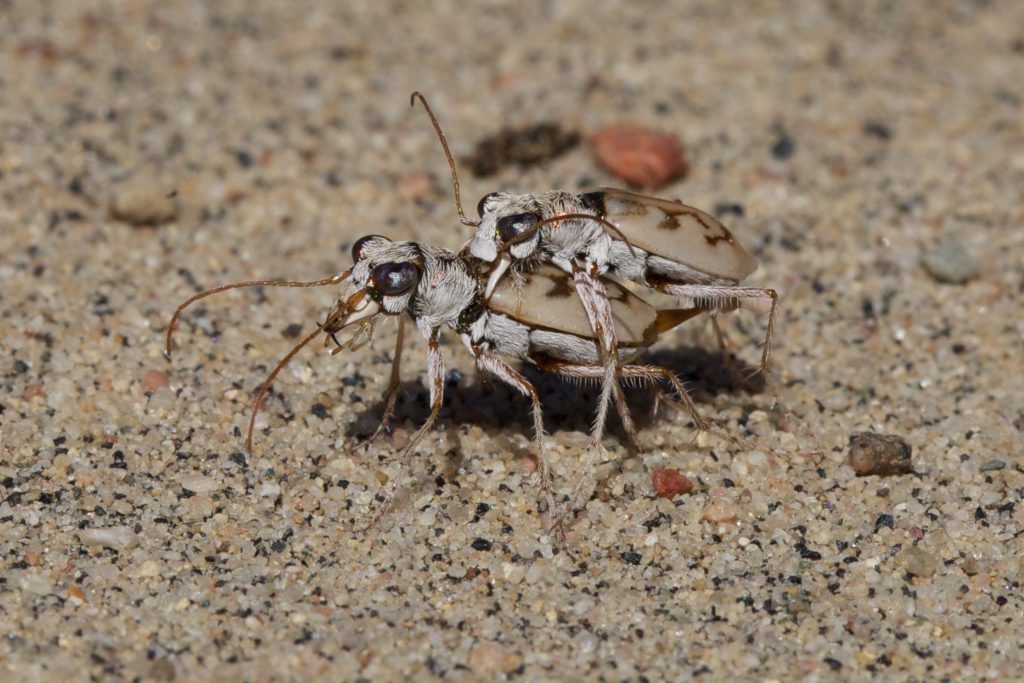
The larvae pupate in early June and come out of the sand at the end of the month. They mate and lay eggs from early July to mid-August. During the mating season in July, the males display an interesting behavior known as mate guarding by mounting on the back of the females to protect their partners from other rival males. Hibernation starts in late September and the adults start to die off.
How to Spot Signs of the Ghost Tiger Beetle in The Dunes
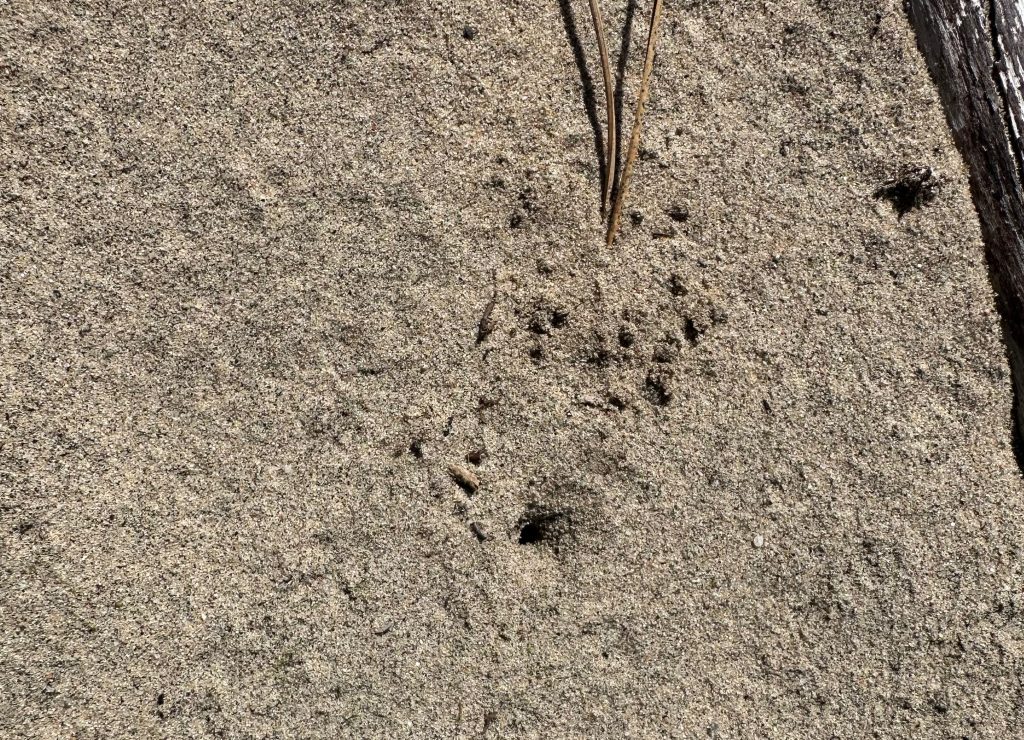
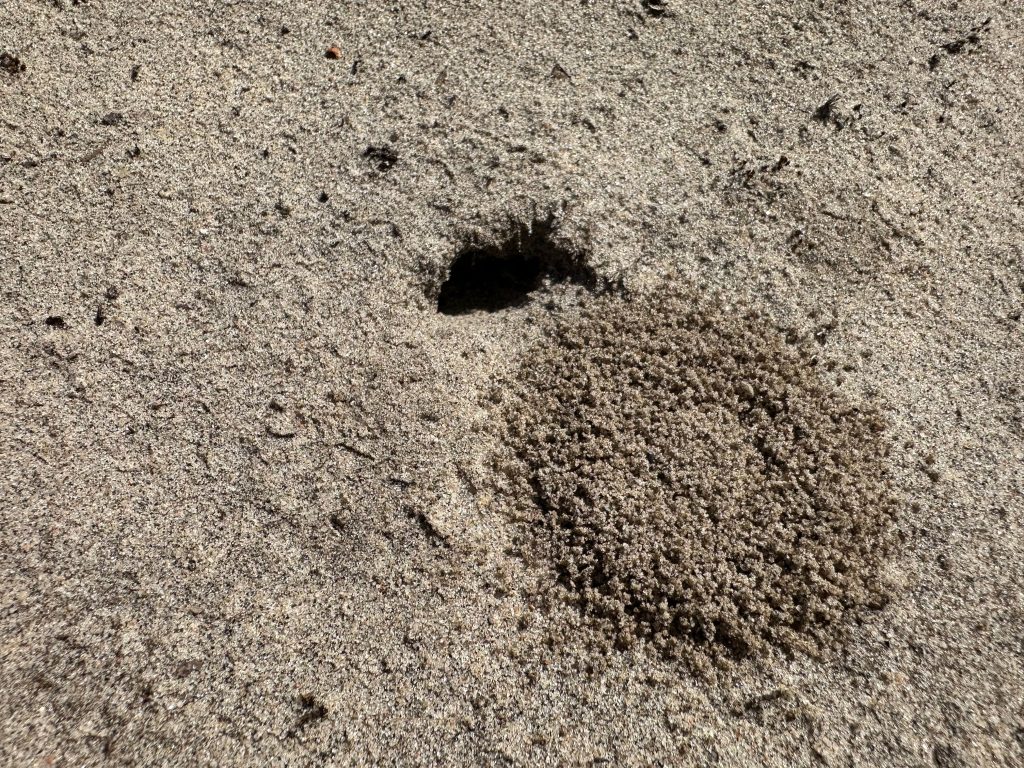
Look for holes in the sand: Larvae and adults dig holes, piling up a small stack of sand to one side of their hole. Adult burrows are crescent shaped. We see lots of darker sand by burrows in the fall as they dig deeper to avoid drowning in early spring.
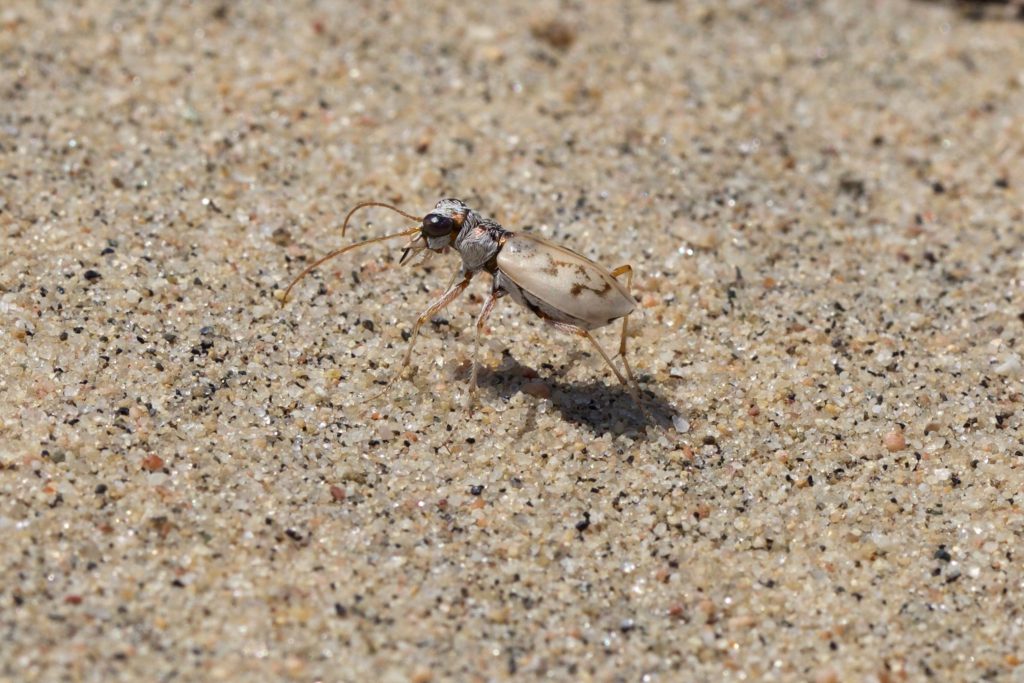
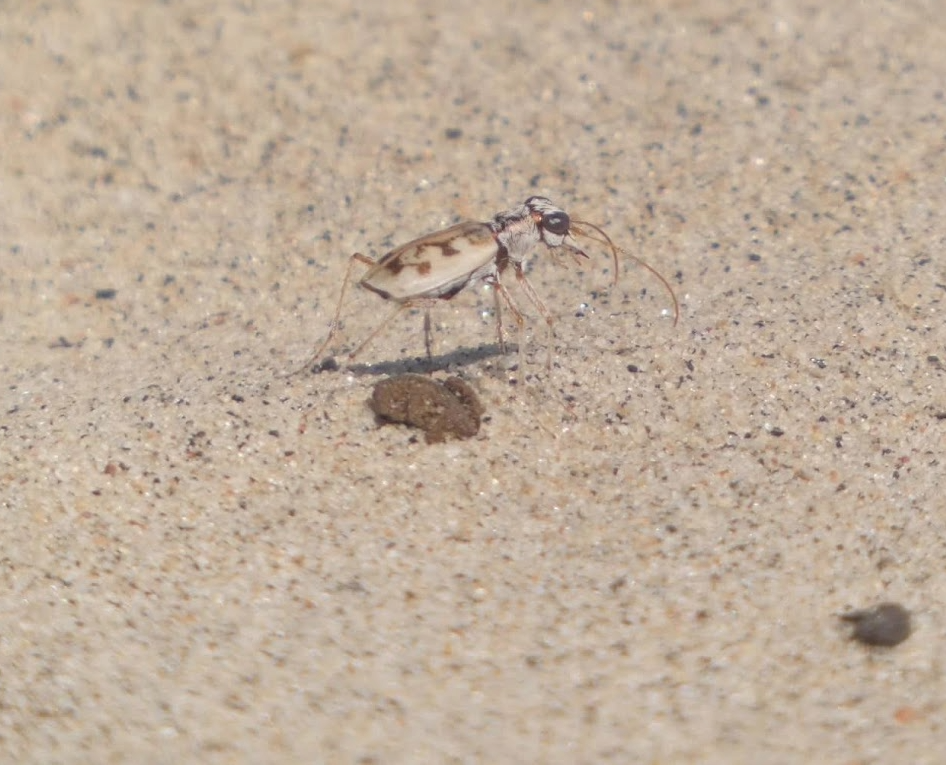
Ghost Tiger Beetle casting a shadow. By Claudia Burns
Watch for the shadow: Ghost Tiger Beetles reach 9–11mm in length and have a cream-white back, often with dark brown markings, and a greyish head and thorax covered with small white hairs. Because they often remain stock-still and the colour camouflages them, they can be hard to see on the sand. An easier way is to look for their shadow.
Check for tracks: In the late spring and early summer, Ghost Tiger Beetles emerge from their burrows and run lightly across the dunes while the larvae leave zipper-like tracks. They tend to come out around 10am to sunbathe but they burrow back around noon. They are also active just before sunset between 7 and 8pm.
Stay still: The best way to find one is to stay still and watch for movement. They are experts at camouflaging themselves but are easier to spot when they run: they run over 120 body lengths/second (350 km/hr if they were a human!) To avoid scaring them off, you can point them out to friends using the shadow of your own finger. We also recommend bringing a good macro lens to zoom in from several feet away.
For more reading, see “Adult and Larval Stages of Tiger Beetles at the Pinhey Sand Dunes”, Henri Goulet et al, in Trail and Landscape 53(1) Jan-March 2019.
Tips For Taking Good Photos At The Dunes
By Ethan Lane-Day
Here are a few tips to help you get the best insect photos you can, straight from those with the most experience photographing them here at the dunes.
1. Consider set up and awareness. What exactly are you hoping to capture? You’ll see plenty of species and activity on any visit, but if you’re after a specific shot or want to raise your odds of a truly great one, a little preparation goes a long way.
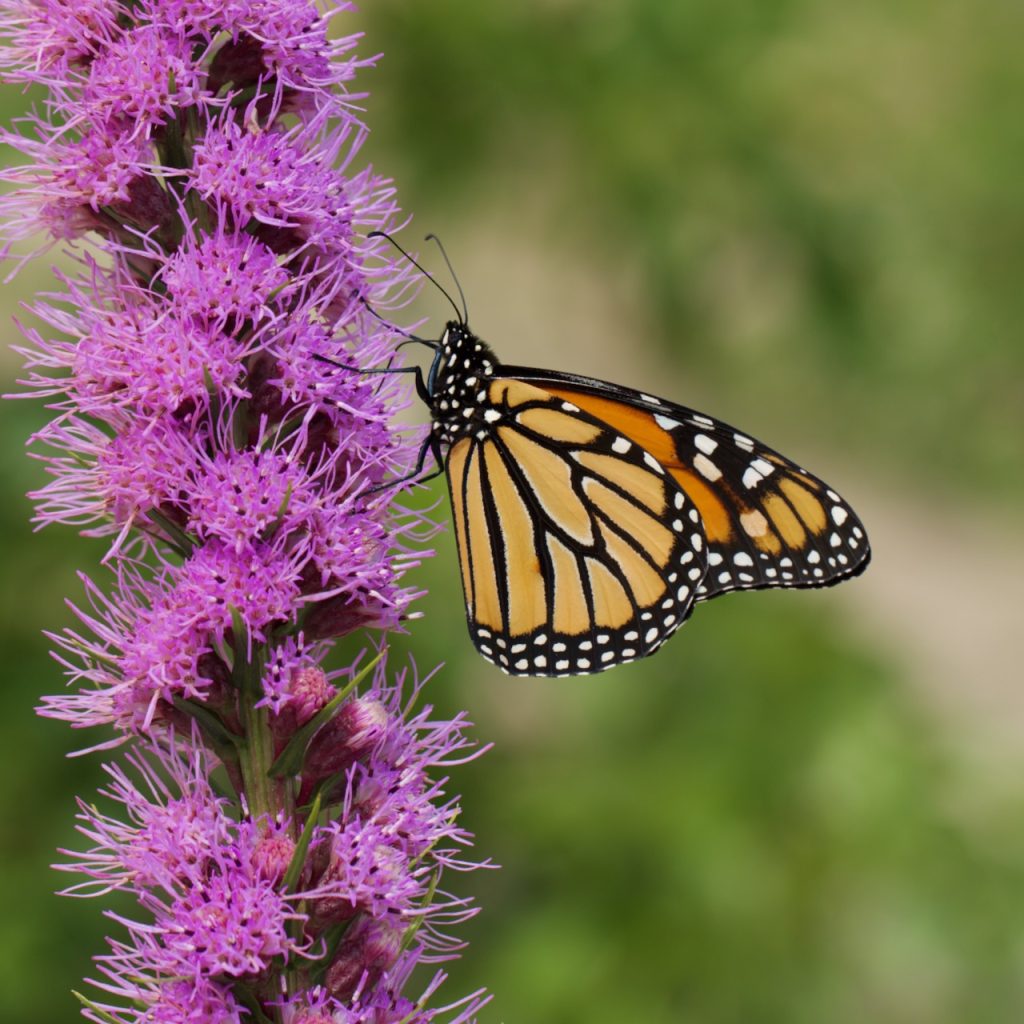
2. Find the right location. Start by researching host plants and where certain insects tend to spend their day. It’s one of the best ways to find insects in their natural habitat, whether that’s on plants, debris or even in the sand itself, like the Blazing Star (Liatris Ligulistylis), which is a butterfly magnet.
The new labels around the dune will help. The dunes are an ideal place for this, since the habitat here has been specifically curated to support insect host plants and other food sources, creating a uniquely diverse environment for photography. It also helps to know migratory patterns and life cycles, so you’re not showing up during a stretch when many species are tucked away or dormant.
3. Start early. Showing up early in the day means insects are still slow and sluggish from the cooler morning air and less responsive to movement, giving you the chance to get in closer for that perfect shot.
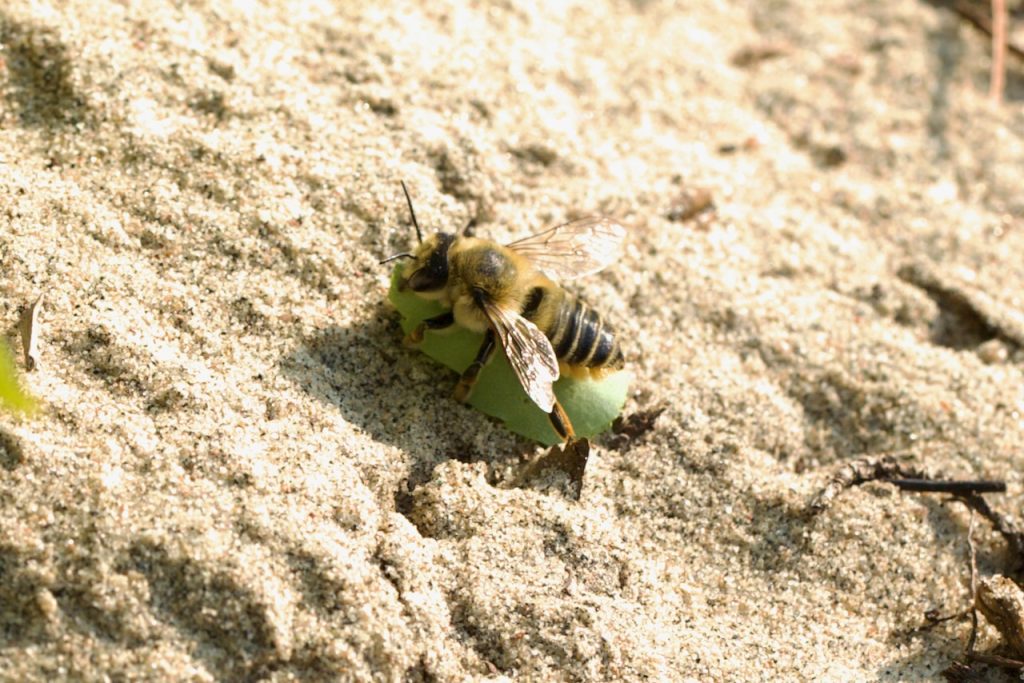
4. Get low, slow, and zoom. Shoot at eye level, move slowly, and use your zoom whenever possible to avoid spooking your subject. You may need to get to sand level like in this picture of a bee. If you find a good subject, stay put for a minute, insects often return to the same perch, and patience will get you a better shot than chasing.
5. Autofocus and set your speed. If you have a good camera, take photos at 1/160th or 1/200th of a second. This is especially helpful for moving insects, shaky arms, and windy conditions, which we often have at the Dunes. Autofocus also helps.
6. Snap often and edit. Use burst mode or live mode on your camera and take lots of photos so you can edit out the poorer ones and keep the best ones. Shoot in RAW with your camera if you can so you can crop and still have a sharp image.
However, be sure to treat the dunes gently while you’re out there. Photograph insects and their habitat without touching or disturbing them, and keep to marked trails so the next visitor gets to see the same diversity you did. This is especially important over the main habitat zones around the dunes where many plants and animals have developed homes that you may not be able to easily see.
So get out there and get that insect shot of your dreams!