
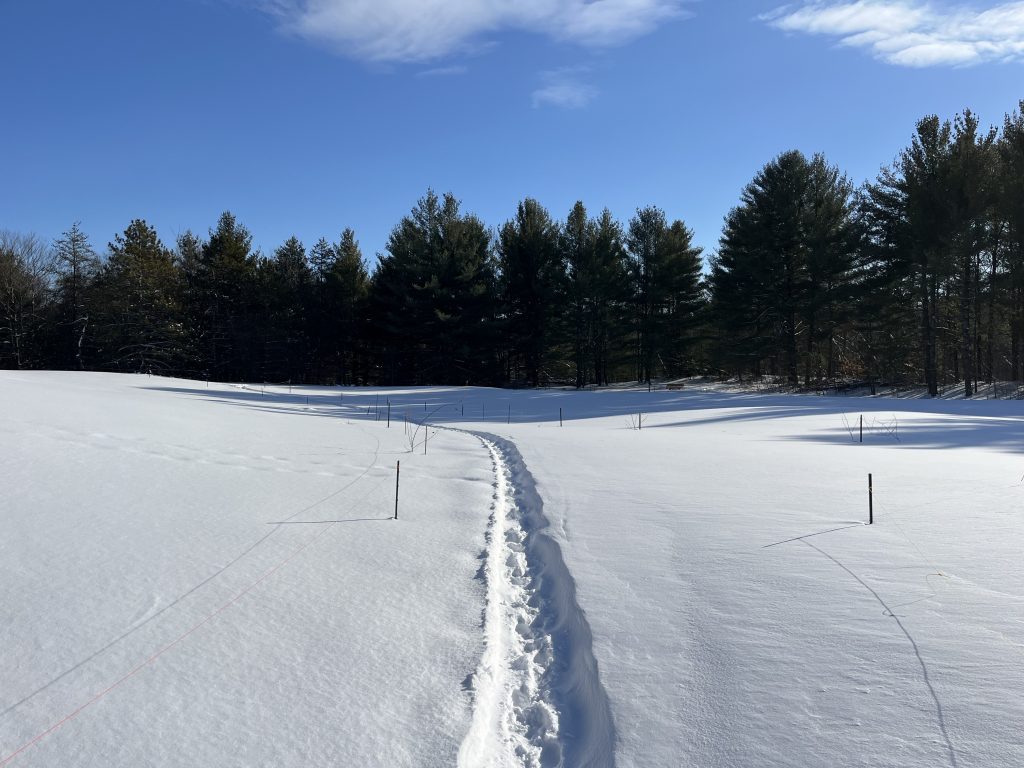
The Pinhey Sand Dunes (PSD) have seen a rollercoaster start to the year weather-wise, with snow all but disappearing and then returning with a vengeance mid-month. All is quiet on the dunes bar footprints of intrepid dog walkers and skiers on the paths and, luckily, fewer signs of humans or their pets on the dunes themselves. The ropes and signage – when and where visible – is clearly helping on that this year versus previous years, meaning flora and fauna rest largely undisturbed.
This newsletter includes:
- An introduction to insect expert Henri Goulet
- Form and function of Dune #1
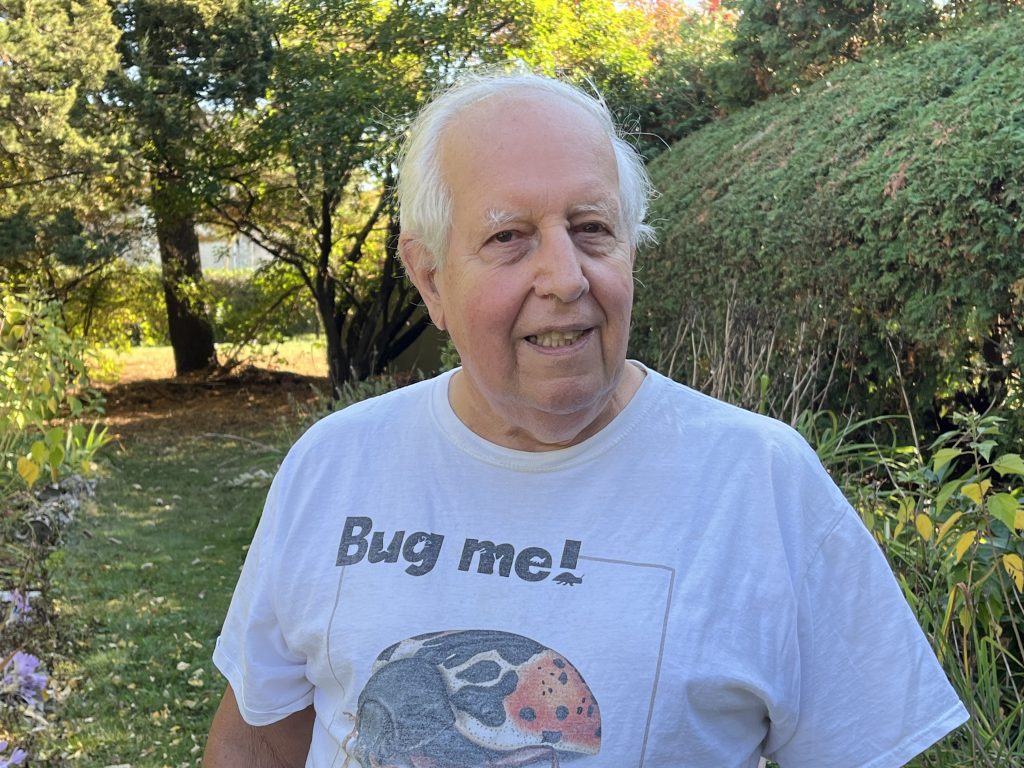
Henri Goulet, His Passion for Dune #1
By Karen Lane
Say hello to Henri.
Henri Goulet, often found at Dune #1 in summer wearing a tell-tale bug-related T-shirt, is one of the co-founders of the Pinhey Sand Dunes project. But his interest in insects – as in the dunes – goes way back.
Born in Jonquieres in Quebec, Henri developed a deep interest in entomology at his countryside boarding school, and built on that with a degree from McGill’s Macdonald College, and then a Phd from the University of Alberta.
Professionally, he focused on sawflies (order Hymenoptera, such as ants, wasps and bees), which are abundant, diverse, and mainly consist of native species in Canada. He worked with Agriculture and Agri-Food Canada from 1978 to identify named sawflies and described many more new species. Personally, his interest has long been in the large beetle family ground beetle. His interest stemmed partly from their diversity – there are 50,000 (in Canada 1,000) species in the family – and partly because of their robustness and their beautiful colour patterns, even though, like many other insects, they are suffering from a slump in numbers due to herbicide use by farmers to protect crops starting in the 1970s.
It was the beetle, specifically sightings of the Ghost Tiger Beetle (Ellipsoptera lepida), that drew Henri in the late 1980s to the then Pinhey Forest “sandpit” in the Dune #1 location.
“I had only seen one Ghost Tiger Beetle before, on Long Point on Lake Eerie,” Henri said. That prompted him to take a closer look, and to keep going back. “For the first few years, I did weeding and photographed about 40 insects.”
And then when BCI President – and long-time friend – Pete Dang got a grant for the Dunes in 2011, Henri himself got a permit from the National Capital Commission to start proper restoration work at the now Dune #1 site, including clearing the area overrun by the invasive poplars and native blackberry in particular, while Pete focussed on the Dune #2. Progress was smooth until the 2022 derecho, requiring new efforts to clear a large swathe of the dunes of downed trees and organic matter.
“Dune #1 is very special, it has survived from almost nothing, but diversity is there, even if you can’t see it immediately. For sure, it’s not as showy as Dune #2 but we have more species of insects, at least 100, at Dune #1,” he said.
Along with his work at the dunes, Henri continues his academic work as Honorary Research Associate for Entomology at Agriculture and Agri-Food Canada. See some of his 100-plus papers here. He continues, too, crucial work in finding better ways of identifying and grouping insects, which marries his passion for the insect-world and his deep expertise in photography. See some of his images here.
Restoring Dune #1’s Form and Function
By Chris Dragan
Our primary task in 2025 was removing the debris piles left over from the 2022 derecho, and adding clean, sifted sand to the newly exposed hill on the northwestern side of Dune #1.
Because there was so much heavy organic matter, the wind wasn’t strong enough to move the sand or clear organic litter and remove these naturally. But now that it has been cleared, the wind will be able to sweep across the dune’s surface and create its characteristic ripple features, which will also help to naturally clear organic matter from its surface in the future.
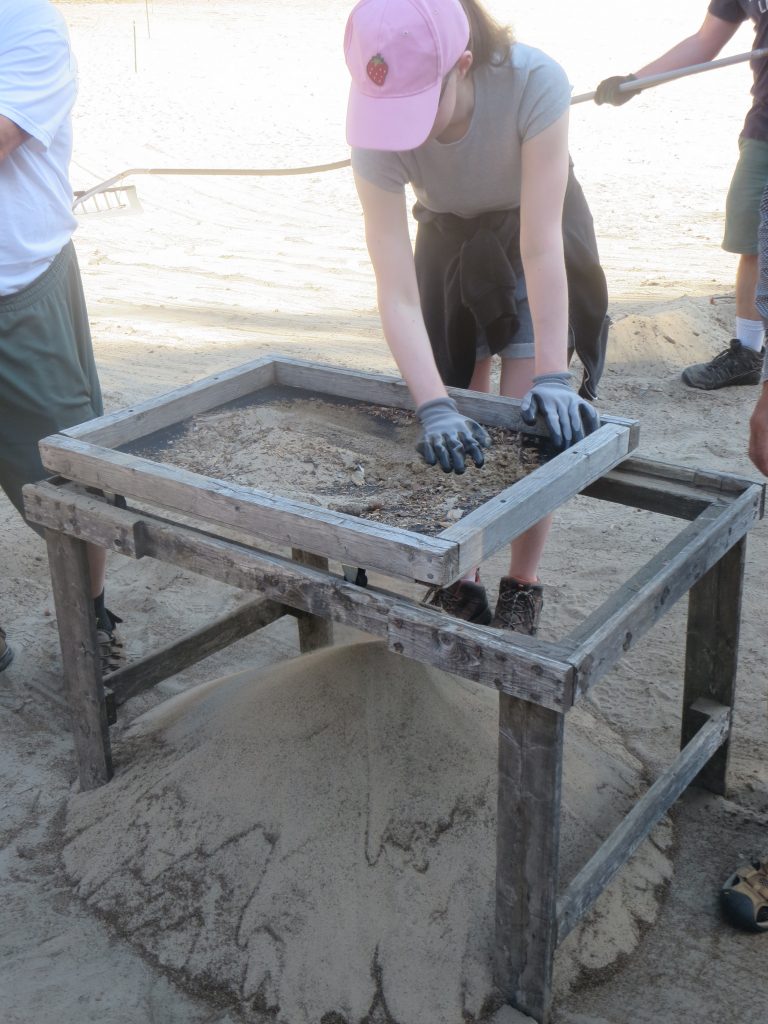
We tossed wood debris to the outer edges of the dune where they will become fertile ground for orchids, in particular, pink lady’s slippers (Cypripedium acaule).
We created two new dunes at the site this way. On average, we raised the peak of the dunes by about two feet, or 60 cm, and raised the area across the small valley by roughly 6-12 inches (15-30cm). This enhanced elevation supports better wind flow and surface dynamics. We also flattened and cleared depressions in the sand caused by animal and human tracks to prevent pools of leaves and organic material building up in the Fall.
Another new project we started this past year was sharing soil samples from the dune with Carleton University for analysis to help us understand what kinds of plants can grow on the site and help us better manage these in the future. We also welcomed a few experts from the Montreal Botanical Gardens who came to take samples of a few of our rare dune plants. Thankfully, we’ve already dealt with most of the unwanted plants at the dune (see last month’s newsletter), and we stayed on top of this by continuing to uproot those we don’t need.
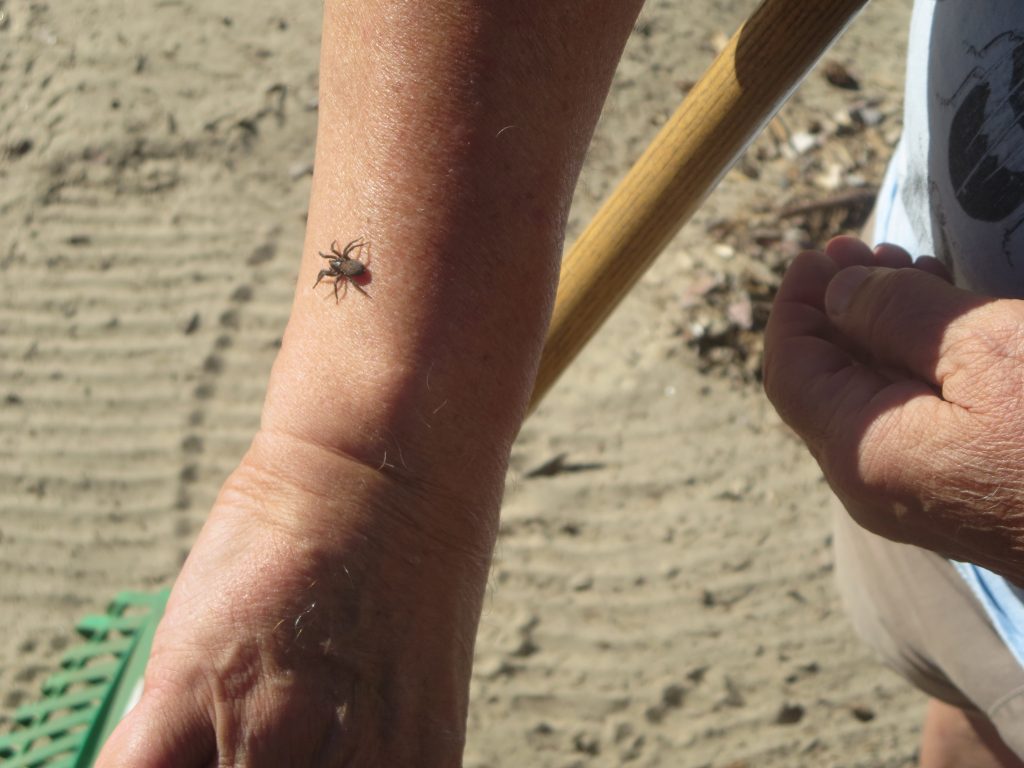
One point of concern has been the collapse of spider biodiversity at Dune #1: we counted only 15 spider species last summer, down from the hundreds we’ve seen in years past. Spider wasps (Pompilidae) and other spider parasites are also becoming scarcer as a result. We believe herbicides from farms up to 100 km away are being carried to the dune by western winds which cause these spiders to go sterile. Moth, beetle, fly, bird and mammal biodiversity has been similarly impacted by this.
There are still over 100 insect species at Dune #1 overall, including several which pollinate, others which clear decomposing organic material, and others which eat other insects. While they aren’t popular, these insects still have a role to play in the environment. Although some people may be confused about why we’re fighting against plant growth at Dune #1, we do this to restore the habit of these unique insects, such as the ghost tiger beetle (Ellipsoptera lepida) who lives deep in the sand to avoid the icy weather in Winter but which can’t burrow beneath anything other than fine sand.
Despite these challenges, we were able to successfully move some insects from Dune #1 to Dune #2 last year to increase the biodiversity at that site.
Stay tuned for our future plans for Dune #1.